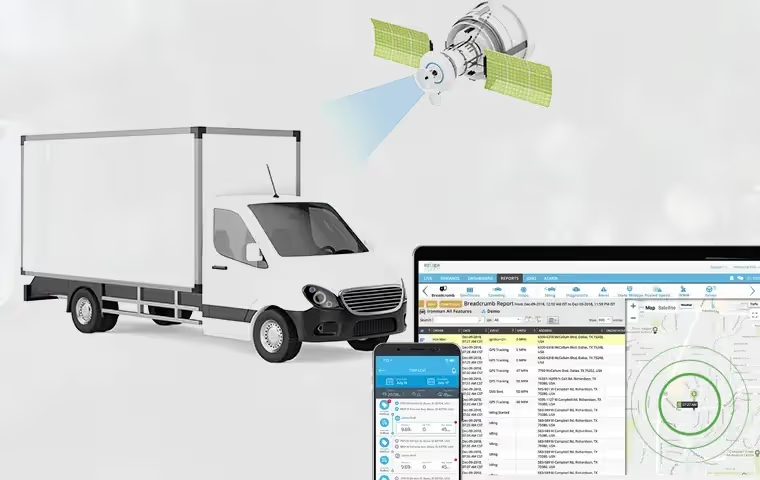
You already know the basics of GPS tracking, maybe from our articles like “A Guide to Fleet GPS Trackers” and “How Does GPS Tracking Work?” But let's get to what really matters. How accurate is GPS vehicle tracking when a few feet can make or break a job? If your tracker shows a vehicle somewhere it isn’t, you lose the very benefits you invested in. This is why understanding geo tracking accuracy is so critical. It’s the foundation for a reliable Azuga GPS tracking system that actually improves your fleet's efficiency and safety.
How does GPS tracking work?
At its core, the Global Positioning System (GPS) is a sophisticated network of satellites orbiting the Earth. Think of it as a massive, invisible grid covering the entire planet. These satellites constantly broadcast signals down to us, carrying precise time and location data. A GPS receiver, like the one in a vehicle tracking device, picks up these signals. By listening to multiple satellites at once, the receiver can perform a quick calculation to pinpoint its exact location on the map. This process happens continuously, allowing for the real-time tracking that is so essential for modern fleet management. It’s this constant communication between space and the ground that makes it possible to see where your vehicles are, where they’ve been, and where they’re headed next.
This technology is the foundation for a smarter, more efficient operation. It’s not just about dots on a map; it’s about having the data you need to make informed decisions. Whether you're coordinating a team of service technicians or managing a long-haul trucking route, understanding the fundamentals of how GPS works helps you appreciate the power of the information it provides. The system is designed for reliability, giving you a clear view of your entire fleet from a single dashboard. This visibility is the first step toward optimizing routes, improving driver safety, and ensuring every asset is exactly where it needs to be, when it needs to be there.
The role of satellites and trilateration
So, how does a receiver turn satellite signals into a precise location? The magic is in a process called trilateration. As Taoglas, a leader in antenna and RF technology, explains, "Satellites send signals with their location and time, and your GPS device uses these signals from at least four satellites to calculate its position." Imagine your vehicle is at an unknown point. A satellite sends a signal, essentially saying, "I'm up here, and you're somewhere on the edge of a sphere that is X miles away from me." By receiving signals from at least three other satellites, the device can find the single point where all those spheres intersect. That intersection point is your vehicle's location on Earth. The fourth satellite helps sync the timing, which adds another layer of accuracy to the calculation.
How accurate is GPS vehicle tracking?
When it comes to managing a fleet, accuracy is everything. A few feet can be the difference between a successful delivery and a confused driver circling the block. The good news is that GPS technology has become incredibly precise, but it's important to understand that not all GPS devices are created equal. The tracker you might use for a personal vehicle or the navigation app on a smartphone operates differently than a system designed for commercial use. For a fleet manager, pinpoint accuracy is critical for everything from dispatching the nearest driver to a job to verifying that a service was completed at the correct address. It also builds trust with your customers when you can provide them with highly accurate ETAs.
The level of precision you need depends on your operational goals. Are you focused on general location awareness, or do you need to confirm a vehicle’s position within a specific loading bay or construction zone? Commercial-grade systems are engineered to minimize the margin of error, providing the reliable data needed for detailed reporting and analysis. This precision directly impacts your ability to optimize routes, monitor driver behavior, and protect your valuable assets. Investing in a high-quality fleet tracking solution ensures you’re working with data you can trust to run a safer and more productive business.
Standard device accuracy
Most of us are familiar with the GPS on our smartphones or in our personal cars. These are what we’d consider standard devices. According to the experts at Tracki, "Most GPS devices are accurate within 3 to 10 meters (about 10 to 33 feet) when outdoors." While that’s impressive for finding your way to a new restaurant, a 33-foot margin of error can be a significant issue in a commercial setting. That could place your vehicle on the wrong side of a street, in a neighboring business’s parking lot, or at the wrong entrance to a large industrial park. For everyday navigation, it’s perfectly fine, but when you need to verify service times or direct a driver to a precise location, that ambiguity can cause delays and frustration.
Commercial-grade fleet tracker accuracy
This is where professional telematics solutions really shine. Commercial-grade trackers are built for a higher standard of precision. As telematics leader Geotab notes, a good receiver using the U.S. government-operated GPS system is typically "accurate within 2.2 meters (about 7 feet) horizontally 95% of the time." This dramatic improvement in accuracy makes a real-world difference. A 7-foot radius means you can confidently tell if your vehicle is at the right loading dock, parked in a designated service area, or located at a specific utility pole. This level of detail is essential for accurate geofencing, precise job validation, and resolving customer disputes. It’s the kind of reliable data that empowers you to manage your assets with total confidence.
Accuracy for speed and timing
Interestingly, GPS is often even more accurate when it comes to measuring speed than it is for pinpointing a static location. According to Lightning GPS, the technology is "usually accurate within ±0.2 to 0.5 mph." This incredible precision is a huge asset for fleet managers focused on safety and compliance. You can get reliable alerts for speeding, helping you coach drivers and reduce risky behaviors before they lead to an accident. This data is also crucial for accurately logging hours of service and ensuring compliance with regulations. By combining precise speed data with location tracking, you get a complete picture of driver performance, which is fundamental to building a strong safety culture within your team.
💡 See Azuga in Action Azuga's fleet management platform helps fleets reduce costs, improve driver safety, and stay compliant — all in one place. Plans start at $25/vehicle/month. Request a Free Demo → | View Pricing →
What Affects Geo Tracking Accuracy?
As previously discussed in this blog, GPS uses radio signal frequencies to determine a vehicle’s location. It measures the time it takes for radio signals to be received from satellites that orbit the earth. Therefore, it makes sense that you may have difficulty with GPS in areas where you do not have a clear line of sight to the sky. Some examples of these areas may include:
- Below high buildings (such as within a city)
- Under tree cover
- Near land formations such as valleys and mountains
- Inside tunnels
- Inside parking garages
Many people think that weather can affect GPS, but this is not the case. The GPS device simply needs a clear line of sight to the sky. However, over time, GPS has evolved to develop stronger signals and supplement with cellular networks to overcome these barriers, so you can rely better on your GPS’s accuracy.
Satellite arrangement
The physical position of satellites in the sky plays a surprisingly big role in GPS accuracy. Think of it like this: if you’re trying to find your position based on signals from three satellites that are all clustered together in one part of the sky, your location fix won’t be very precise. However, if those satellites are widely spread out, your receiver can get a much more accurate reading. According to experts at Taoglas, when satellites are too close together, accuracy suffers, but it improves when they are farther apart. This geometric arrangement is constantly changing as satellites orbit the Earth, which is one reason why you might see slight variations in accuracy throughout the day.
Signal interference in urban areas
If your fleet operates in a dense city, you’ve likely encountered the “urban canyon” effect. This happens when tall buildings block the direct line of sight between your GPS device and the satellites. The signals that do get through often bounce off multiple buildings before reaching the receiver, a phenomenon known as multipath error. This can trick the GPS into thinking your vehicle is on an adjacent street or further down the road than it actually is. As noted by Geotab, these bounced signals are a primary cause of reduced GPS accuracy in metropolitan areas, making reliable tracking technology essential for urban fleets.
Atmospheric conditions
Even a clear sky isn’t completely empty. As GPS signals travel from space to your vehicle, they have to pass through the Earth’s atmosphere, specifically the ionosphere and troposphere. These layers can slightly slow down and bend the signals, which can introduce small errors in the location calculation. While this delay is minuscule, it can translate to a location error of anywhere from two to ten meters. Though you can’t control the atmosphere, it’s one of the many variables that high-quality GPS systems are designed to account for to deliver the most precise data possible for your fleet.
GPS receiver and antenna quality
Not all GPS devices are created equal. The quality of the internal components, especially the receiver and antenna, has a direct impact on performance. A superior receiver can lock onto faint satellite signals and better distinguish between real signals and reflected multipath signals. As tracking experts at Tracki point out, better GPS receivers and antennas simply lead to better accuracy. This is why commercial-grade fleet tracking hardware often provides more reliable and consistent data than a standard smartphone, as it’s purpose-built for sensitivity and performance in challenging environments.
Outdated mapping software
Sometimes, the problem isn’t the GPS tracker at all—it’s the map. Your device might be reporting the exact coordinates of your vehicle with pinpoint accuracy, but if the mapping software it’s displayed on is out of date, it can look like an error. For example, if a new highway is built and the map hasn’t been updated, your vehicle might appear to be driving through an empty field. This is an important distinction; the GPS location can be correct, but the visual representation is wrong because the map itself has old data.
How can you improve GPS accuracy?
While some factors like satellite geometry and atmospheric conditions are out of your hands, you’re not powerless. There are several practical steps you can take and features you can look for in a GPS system to ensure you’re getting the most precise and reliable location data for your fleet. Focusing on the right technology and proper setup can make a significant difference in the quality of the information you receive, helping you manage your operations more effectively.
Use devices with multi-GNSS support
The term “GPS” technically refers to the satellite system owned by the United States. However, there are other global navigation satellite systems (GNSS), like Russia’s GLONASS and Europe’s Galileo. Devices that are equipped with multi-GNSS support can pull data from more than one of these systems simultaneously. The advantage is simple: more available satellites mean a higher likelihood of getting a fast, strong, and accurate position lock. According to Tracki, devices that use multiple satellite systems tend to be more accurate, especially for fleets that operate across wide geographical areas.
Leverage assisted GPS (A-GPS) technology
Assisted GPS, or A-GPS, is a technology that enhances standard GPS performance by using cellular networks to speed up location finding. It helps your device get a faster initial fix on its location by pulling data from cell towers to determine which satellites are overhead. This is particularly useful in those tricky urban canyons where satellite signals are weak or obstructed. By combining satellite signals with data from cell towers and even Wi-Fi networks, A-GPS provides a more robust and accurate location, helping you keep tabs on your vehicles even in challenging environments.
Ensure proper device placement
One of the most straightforward ways to get better GPS performance is to ensure the tracking device is installed correctly. GPS trackers work best when they have a clear, unobstructed view of the sky. For vehicles, this often means placing the device on or under the dashboard, where it can easily receive satellite signals through the windshield. You’ll want to avoid installing it under large metal components or deep within the engine bay, as these materials can block or interfere with the signals and significantly reduce the accuracy of your location data.
Common GPS tracking problems explained
Ever looked at your fleet map and seen something that just didn’t seem right? A vehicle that appears to be moving while parked or a location that’s slightly off can be confusing. Most of the time, these are not system failures but rather known quirks of how GPS technology works. Understanding these common issues can help you interpret your fleet data more accurately and manage expectations.
GPS drift
GPS drift is what happens when a stationary vehicle appears to be moving slowly on the map. This is caused by tiny, unavoidable fluctuations and atmospheric interference in the satellite signals reaching the receiver. Your recorded position might seem to jump around slightly, which can lead to minor inaccuracies in speed and distance readings if not properly filtered. High-quality fleet management systems use sophisticated algorithms to smooth out this data, recognizing when a vehicle is truly idle and preventing false reports based on this natural signal variation.
Indoor and underground limitations
The fundamental requirement for GPS to work is a direct line of sight to orbiting satellites. Because of this, the high-frequency, low-power signals struggle to penetrate solid structures like buildings, tunnels, and underground parking garages. This is why a vehicle’s location might not update or may appear frozen at its last known position when it’s inside a service bay or parked in a multi-story garage. Once the vehicle moves back into an open area, the device will reacquire the signals and update its location on your map.
Is military GPS more accurate?
It’s a common belief that military-grade GPS is far more accurate than the systems available to the public, but this is largely a myth today. Decades ago, the U.S. government intentionally degraded the accuracy of civilian GPS signals through a feature called Selective Availability. However, this was turned off in the year 2000. Since then, advancements in civilian receiver technology have closed the gap significantly. Modern, commercial-grade GPS trackers can achieve remarkable precision, providing reliable and accurate location data that is more than sufficient for even the most demanding fleet management applications.
Get Pinpoint Accuracy with Azuga GPS Tracking
Azuga’s experts have been working with fleets of all shapes and sizes for years to accomplish all kinds of fleet management goals. Fleet tracking is just one of the many services we offer. Our fleet tracking device installs in as little as 20 seconds and can track not only your vehicles but your assets as well. You can hook this fleet tracking device up to a comprehensive fleet management solution covering all aspects of your fleet’s operations, from safety to finances to maintenance and beyond.
Note
Ready to take your fleet further? Join 400,000+ drivers using Azuga to track smarter, drive safer, and run more efficiently. Schedule Your Free Demo → | Calculate Your Savings →
Frequently Asked Questions
Why is a commercial-grade tracker more accurate than my smartphone's GPS? While your phone is great for getting around town, it's built for general use. Commercial-grade trackers, like those from Azuga, are purpose-built with superior receivers and antennas. This specialized hardware is designed to achieve a much higher level of precision, typically pinpointing a vehicle's location within about 7 feet. In contrast, a standard phone's GPS can have a margin of error of up to 33 feet, which can make a big difference when you need to verify service at a specific address.
My vehicle is parked, but the map shows it moving slightly. What's happening? This is a common phenomenon known as GPS drift. It's caused by tiny, unavoidable variations in the satellite signals as they travel through the atmosphere. Even when a vehicle is completely stationary, these fluctuations can make the location marker appear to wander a few feet. Professional fleet management systems are designed with smart filters that recognize this drift, ensuring it doesn't create false alerts or inaccurate reports for things like idle time or mileage.
Will rain, snow, or cloudy days affect my fleet's GPS tracking? This is a common misconception, but the short answer is no. The radio signals from GPS satellites are not blocked by weather conditions like clouds, rain, or snow. The most important factor for accuracy is a clear line of sight to the sky. As long as the device isn't physically obstructed by something solid, like a concrete parking garage or a metal roof, it will receive signals just fine regardless of the weather.
What's the easiest way to make sure my GPS trackers are as accurate as possible? Proper installation is the single most effective step you can take. A GPS device needs an unobstructed view of the sky to communicate effectively with satellites. The best placement is typically on or under the dashboard, close to the windshield. Avoid installing the unit deep in the engine bay or underneath large metal surfaces, as these materials can block or interfere with the signals and reduce the accuracy of your location data.
If my tracker is accurate, why does it sometimes show a vehicle on the wrong street in a big city? This is usually due to the "urban canyon" effect. In dense downtown areas, tall buildings can block the direct signal from satellites. The signals that do get through often bounce off several buildings before reaching your device. This is called a multipath error, and it can trick the receiver into calculating a slightly incorrect position. Modern systems often use Assisted GPS (A-GPS), which leverages cellular data to help confirm a vehicle's location and minimize these errors in challenging urban environments.
Key Takeaways
- Commercial-grade GPS is non-negotiable for fleets: While your phone's GPS is fine for personal trips, its potential 33-foot error margin is too large for business operations. Professional trackers offer accuracy within about 7 feet, providing the reliability you need to verify service locations and manage assets precisely.
- Know what affects your signal accuracy: GPS performance isn't always constant; it can be influenced by tall buildings, atmospheric conditions, and satellite positions. Understanding these factors helps you interpret your fleet data more effectively, especially in dense urban or remote areas.
- Improve precision with the right technology and placement: You can get more reliable location data by choosing devices that use multiple satellite systems (multi-GNSS). Just as important is proper installation, which means placing the tracker where it has a clear, unobstructed view of the sky.